Jewelry retouching: what actually matters when the product is a one-of-a-kind piece
If you run e-commerce or creative for a fine jewelry brand, someone has already quoted you $0.99 an image. Maybe $2. The pitch is always the same: unlimited revisions, 24-hour turnaround, sparkle enhancement included.
This article is about what that price buys, and what it costs you the first time a customer puts a loupe next to your product page.
Jewelry is the least forgiving category we retouch. A garment tolerates interpretation and a diamond does not. The person looking at the image has often seen the piece in a salon, up close and under good light, and the photo has to survive that comparison. When it fails, you don't get a complaint. You get a return, and you never learn why.
We have been retouching jewelry since 2006. Here is what we have seen hold up, and where we see it break.
What jewelry retouching actually involves
Most vendors describe jewelry retouching as a list of Photoshop operations: clipping path, spot heal, dodge and burn, sparkle. That list describes the tools. The work itself is a sequence of decisions, and in our studio it runs through 4 stages, with different people at each one:
- Stage 1. Intake. We receive the files, set up the layer structure, make the first global adjustments and assign the batch. Reference material matters most here: the certificate, the physical sample photo and the brand's previously approved frames.
- Stage 2. Retouch. Cleanup, color correction, reflection management and background. Each retoucher works to the client's own style guide, not to a house style.
- Stage 3. Quality control. A second, senior retoucher checks every image against the brief and checks consistency across the whole batch. This stage catches what the first retoucher stopped seeing 3 hours in.
- Stage 4. Delivery. We package the files to the client's exact spec and deliver them through the client's preferred channel.
A $0.99 price cannot include stage 3, and the reason is arithmetic. QC on jewelry is slow, it needs your most experienced people, and it does not scale. It is also the only stage that catches the errors that cost you a sale.
Facets are information, not sparkle
The amateur instinct is to add sparkle. A professional protects the information in the stone.
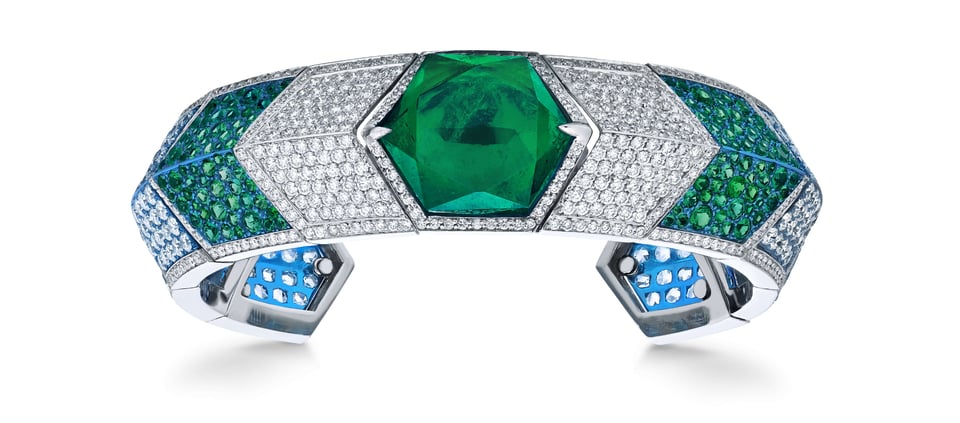
Every facet on a cut stone is a small mirror that records the geometry of the cut. Blur it, over-sharpen it or paint a highlight onto it, and you have changed what the stone claims to be. An "enhanced" brilliant cut starts to read as a lower-quality stone with post-production on top, because that is what it has become.
In practice:
- Clean, do not construct. Dust, fibers and polishing marks come out. The facet pattern underneath stays exactly as photographed.
- Sharpen locally or not at all. A global unsharp mask across a ring crushes facet edges into uniform glitter. If a stone needs local contrast, it gets it on a masked layer at the facet cluster, judged at 100%.
- Never paint a star. Added highlight flares are the most common sign of cheap jewelry retouching. A real facet highlight has the shape of the facet. A painted one has the shape of a brush.
- Check the pavilion. Light coming back through the bottom of the stone carries most of the information about cut quality. It is also the first thing lost when someone lifts the shadows to make an image "pop."
If you audit one thing on a returned file, open it at 100% on a single facet cluster and ask whether a camera could have produced that pattern.
Metal is a mirror you have to edit around
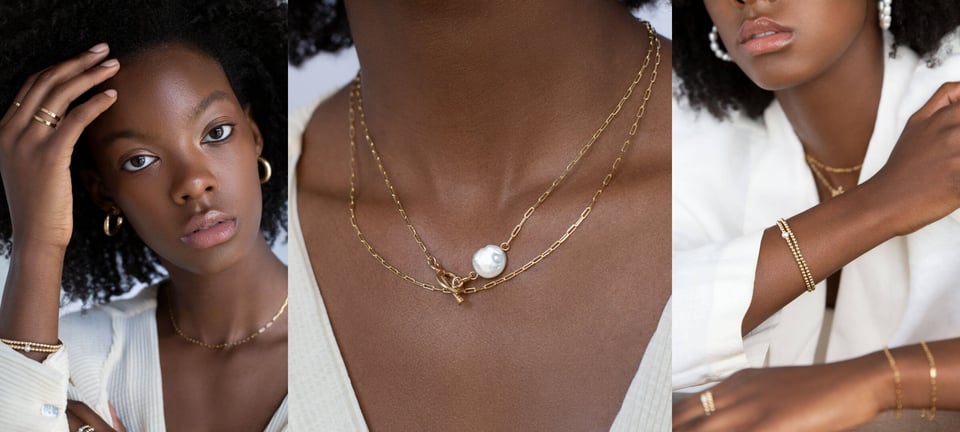
Polished gold and platinum reflect the whole studio: the softbox, the tent, the table, sometimes the photographer. You cannot take all the reflections out, because the eye reads the shape of the metal from them.
The job is deciding which reflections describe form and which are noise. Strip too much and the metal goes flat and gray and looks computer-generated, which makes a 5-figure piece read as costume. Leave too much and the piece looks dirty and the photography looks amateur.
The right amount sits between those two, and we decide it frame by frame, because the same ring photographed at 2 angles has 2 different reflection problems.
One test we use is to cover the stone and look at the metal alone. If you can still tell where the band curves, where it is flat and where the shoulder rises to the setting, the reflections are doing their job. If it reads as a vague silver shape, too much has been removed.
One delivered image is often 10 captured images
Almost nobody outside a studio understands this part of high-end jewelry work, and it is where the cheap quote falls apart.
Shoot a ring at macro distance and your depth of field is a couple of millimeters. Focus on the center stone and the shoulder goes soft. Focus on the shoulder and the far prong disappears. Stop down to f/16 for more depth and diffraction starts to erase the facet detail you were trying to protect. No single exposure renders a whole ring sharp.
So the piece is shot as a stack. The framing stays the same while the focus steps through the object, 3 to 10 captures on a ring and more on a necklace or a complex multi-stone setting. The retoucher then aligns those frames and blends them into one file where the whole piece is in focus, without leaving these marks:
- Ghosting at transitions where 2 frames disagree about an edge.
- Halos where the blend boundary crosses a facet edge or a prong tip.
- Plastic uniformity, the sign of an automated stack left unfinished. Nothing in the frame has any focus falloff, and the piece stops reading as a physical object.
Automated stacking software does most of the job. The rest is done by hand, and it is always in the hardest places: prong tips, chain links, the edge of a faceted stone against the background. That part is a person at 100%, making decisions.
Now do the volume math. A 40-SKU shoot with 3 angles per SKU and 5 frames per stack is 600 captures behind 120 delivered images. The client is invoiced for 120 images. The studio processed 600 files, aligned 120 stacks and hand-finished every blend boundary.
This is where $0.99 an image collapses. It is a price for one capture, quoted as if it were the finished file.
Not every jewelry image needs this
The opposite mistake is expensive too.
A silver stud on white for a marketplace listing, a row of thin stacking bands shot straight on, most costume and fashion jewelry: these need a single capture, standard cleanup, background and color correction. We do plenty of that work, and it runs at a different price and a different turnaround. Treating it as couture retouching spends your budget on attention the product does not need.
The real failure is buying the wrong tier. Paying stack-level rates for simple studs wastes money. Buying single-capture rates for a pave cocktail ring gets you a file where half the ring is soft and someone has sharpened it to hide that.
Ask your vendor which tier they are quoting, and whether it includes stack alignment and blend finishing. If they cannot answer, they are quoting the cheap one.
Color is a legal problem, not just an aesthetic one
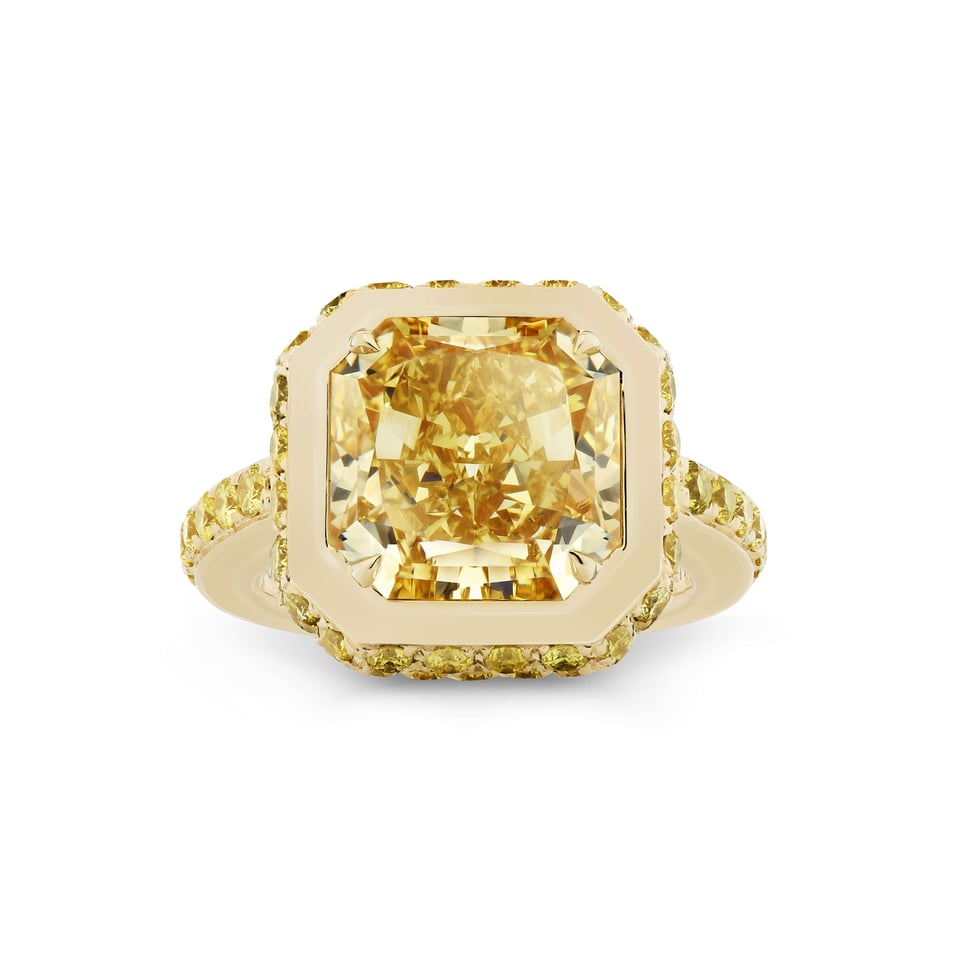
A yellow diamond rendered warmer than life. A rose gold drifting toward copper. A sapphire pushed bluer because it looked better on the retoucher's monitor.
At luxury price points these are not style choices. They misrepresent a graded, certified, priced attribute, and in most jurisdictions selling on that basis is a consumer protection problem before it is a question of taste.
So we correct against reference, not taste:
- Where a stone has a certified color grade, the certificate governs. The art director's preference and last season's imagery do not.
- We make color decisions on a calibrated display and lock them at batch level, so image 40 matches image 1.
- Where a brand's site and its print material disagree, we ask rather than average.
This is the least glamorous part of any retouching brief, and the part most often skipped when a vendor works at volume for a dollar an image. That price leaves no time to check anything against anything.
The volume paradox
High-end jewelry is made one piece at a time, then sold at e-commerce volume, and every delivered frame may be 5 or 10 captures deep.
We have been doing this for 20 years. From the work currently running through our tracked pipeline:
- Lugano Diamonds, since October 2022: 101 delivered batches, 1,118 images.
- Jennifer Fisher, since September 2024: 27 batches, 1,528 images.
The image count matters less than the fact that both relationships run over years, in repeat batches. Nobody sends a 101st batch to a studio whose work does not hold up. If we were buying, that is the number we would look at, rather than a homepage claiming 1,000+ happy clients without naming any of them.
The answer to the volume paradox is process, not speed. Lighting and stacking specs are agreed with the photographer up front, color is locked at batch level, and a senior retoucher checks every frame before anything is delivered.
How to brief a jewelry retoucher
Most bad jewelry retouching starts with a bad brief. Send these 6 things and you will get better work from any competent studio, including ours:
- The certificate or the graded color. For any stone where color is a specified attribute. A scan is fine.
- All frames in the stack, not the sharpest one. If you send one capture from a 7-frame stack, the depth information is gone and no amount of retouching brings it back.
- One physical reference photo. Shot in daylight next to the actual piece, even on a phone. It settles more arguments than any written description.
- Three previously approved frames. Your own approved files that show the look you want kept. Mood board images don't count.
- Your delivery spec in full. Color space, bit depth, file format, dimensions, naming convention and background value. Get this wrong and you pay for a second pass on the whole batch.
- What you do not want touched. Patina on antique settings, deliberate asymmetry, a signature imperfection. Retouchers remove anomalies by default unless you tell them the anomaly is the point.
What to check before you approve a batch
Open 5 images at 100%, rather than the whole batch at thumbnail size, and check:
- One facet cluster. Does the pattern look photographed or painted?
- The metal with the stone covered. Can you still read the form?
- Blend boundaries on a stacked file. Follow a prong tip and a chain link at full zoom. That is where ghosting and halos show up.
- A certified stone against the certificate. Compare it with the document, not with your memory of it.
- Image 1 against image 40. Same white balance, same background value, same shadow density.
- The edge of the clipping path at high zoom. Halos and chewed prongs show up here too.
Checking 5 images takes about 10 minutes, and it catches most of what would otherwise reach your product page.
Frequently asked questions
What does jewelry retouching cost?
It depends on complexity and volume, not on a flat per-image rate. A simple stud earring on white and a focus-stacked pave ring with a certified center stone are different jobs, and a studio quoting one price for both has not looked at your files. We quote on a sample of your actual images.
What is focus stacking, and why does it change the price?
At macro distances only a few millimeters of a piece can be in focus at once, so the photographer shoots the same frame several times, stepping the focus through the object. The retoucher aligns and blends those captures into one fully sharp file, then finishes every blend boundary by hand. One delivered image can sit on top of 10 captures, which is why per-image pricing built for single captures breaks down on high-end jewelry.
How long does jewelry retouching take?
Batch turnaround is measured in days, not weeks. Rush work is possible, but on jewelry we would rather give you a realistic date than cut QC short, because QC is the stage that protects you.
Can AI do jewelry retouching?
AI handles the routine passes well: dust removal, background separation, batch consistency checks and a first pass at stack alignment. It is not reliable at the judgment calls this article is about, because those require knowing what the stone really is. In our studio AI assists and a senior retoucher makes every ship decision.
Should I retouch jewelry differently for a PDP versus a campaign?
Yes. A PDP image has to be accurate. A campaign image can carry mood and atmosphere, and it can lose detail on purpose. The mistake is giving a PDP frame the campaign treatment.
If your product survives a loupe, your imagery should survive a zoom
That is the standard, and you can test any file against it.
We hold every jewelry frame to that standard, and the same approach runs across our fashion, e-commerce and beauty retouching.
Want jewelry imagery that holds up next to the piece? Talk to us.